
If you’re thinking about moving into cybersecurity, you’re looking at the right field in the right place at the right time. The Washington, D.C. metro area is the densest cybersecurity job market in the United States—and you don’t need a four-year degree or a decade of experience to break in.
This guide walks you through what the work actually involves, the skills and certifications that get you hired, and a realistic roadmap from beginner to working professional. It’s written for career-changers and working adults in the **Northern Virginia** region who want a clear, no-hype path forward.
Why Northern Virginia Is One of the Best Places to Launch a Cybersecurity Career
Few places on earth concentrate cyber demand like the D.C. metro. Three forces stack up here:
- Government and defense. Federal agencies and their contractors hire continuously for security roles, many tied to clearances.
- Data Center Alley. Loudoun County routes a huge share of the world’s internet traffic – and all of it needs defending.
- Private-sector growth. Finance, healthcare, and tech employers across Fairfax and Arlington compete for the same talent.
Nationally, the U.S. Bureau of Labor Statistics projects information-security-analyst roles to grow 28.5% from 2024 to 2034 – the fastest-growing computer occupation, with about 16,000 openings a year (U.S. Bureau of Labor Statistics). Live demand maps like CyberSeek consistently show the D.C.–Virginia corridor as a top hiring region (CyberSeek cybersecurity supply/demand heat map).
Translation: if you build the right skills locally, the jobs are already next door.
What Skills and Certifications Do You Actually Need?
Cybersecurity is broad, but every path starts on the same foundation: how networks, operating systems, and data actually move and break. From there you specialize.
A practical progression looks like this:
| Stage | Focus | Typical certification | Best for |
|---|---|---|---|
| Foundations | Networking, OS, security fundamentals | CompTIA Security+ | Total beginners |
| Cloud security | Securing AWS workloads & identity | AWS Cloud Practitioner → Solutions Architect | Cloud-bound roles |
| Engineering | Hands-on defense, monitoring, hardening | Vendor + practical labs | Analyst/engineer tracks |
| Governance (GRC) | Risk, compliance, audit, frameworks | GRC-focused credentials | Policy & audit roles |
At Tysons Institute, this maps directly to a structured sequence –Modern Cyber Foundations, Applied Cyber Engineering, and Governance, Risk & Compliance (GRC) – so you’re never guessing what to learn next. Explore the cybersecurity programs
Pairing security with cloud skills is one of the highest-leverage moves you can make. Most modern infrastructure runs in the cloud, so AWS-literate security professionals are especially in demand. See the AWS Academy courses
A Realistic Roadmap: From Beginner to Hired
You don’t need to do everything at once. Follow the order:
- Assess where you are. Comfortable with computers but new to security? Start at foundations—no prior IT job required.
- Build the fundamentals. Networking, operating systems, and core security concepts come first; everything else builds on them.
- Get hands-on early. Reading isn’t enough. Labs, real tools, and instructor feedback are what make skills stick.
- Earn a certification employers recognize. A credential like Security+ (and an AWS cert for cloud roles) signals you’re job-ready.
- Build a small portfolio. Document labs, a home setup, or a capstone project you can talk through in interviews.
- Network locally and apply. Tap the dense NoVA employer market, meetups, and your school’s connections.
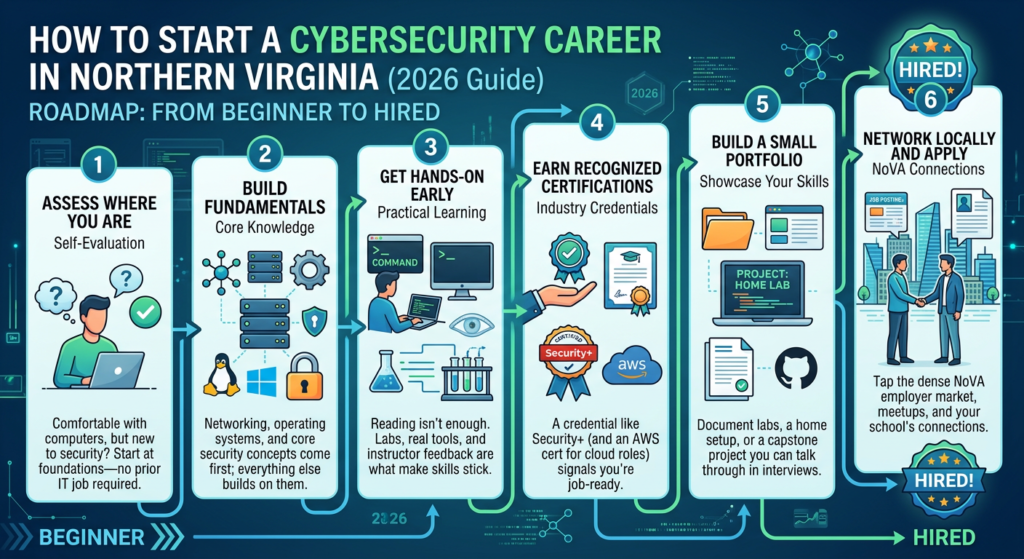
Cyber Career Path Infographic – Roadmap: From Beginner to Hired
Most motivated career-changers can move through foundational training in a matter of months—especially with a structured program rather than scattered free videos.
How Tysons Institute Helps You Get There
Tysons Institute has trained Washington-area professionals for roughly 30 years, and it’s certified by the State Council of Higher Education for Virginia (SCHEV). For a career-changer, a few things matter most:
Small classes, hands-on instruction. You learn by doing, with an instructor who knows your name.
Built for working adults. Morning, evening, and weekend schedules let you train without quitting your job.
Affordable, with flexible payment plans. Cost shouldn’t be the reason you stay stuck.
Official AWS Academy curriculum. Cloud skills that complement your security training. AWS Academy at Tysons Institute
Convenient Vienna, VA location. Near Metro and I-495, with free parking.
Support for international students and ESL learners.
Whether you’re aiming for an analyst seat, a cloud-security role, or a GRC track, the path is structured end-to-end. About Tysons Institute.
FAQ
How long does it take to start a cybersecurity career?
With focused, structured training, many career-changers build job-ready foundations in a few months—then continue specializing while they begin applying. Your pace depends on schedule and starting point.
Do I need a college degree to work in cybersecurity?
No. Many employers prioritize demonstrable skills and recognized certifications over a specific degree, especially for entry and mid-level roles.
What’s the job market like in the D.C. and Northern Virginia area?
It’s one of the strongest in the country, driven by government, defense contractors, data centers, and private industry. Demand for security talent consistently outpaces supply locally.
Can I train while working full-time?
Yes. Tysons Institute offers morning, evening, and weekend classes specifically so working adults can reskill without leaving their current job.
Do you support international students?
Yes—Tysons Institute provides ESL instruction and international student services alongside its technical programs.
Ready to Make the Move?
Cybersecurity is one of the few fields where local demand, strong pay, and an accessible entry path all line up at once—and Northern Virginia is the ideal launchpad. The hardest part is simply starting.
If you’re ready for hands-on cybersecurity training in Northern Virginia, Tysons Institute can map your path from foundations to a recognized certification. Contact us.