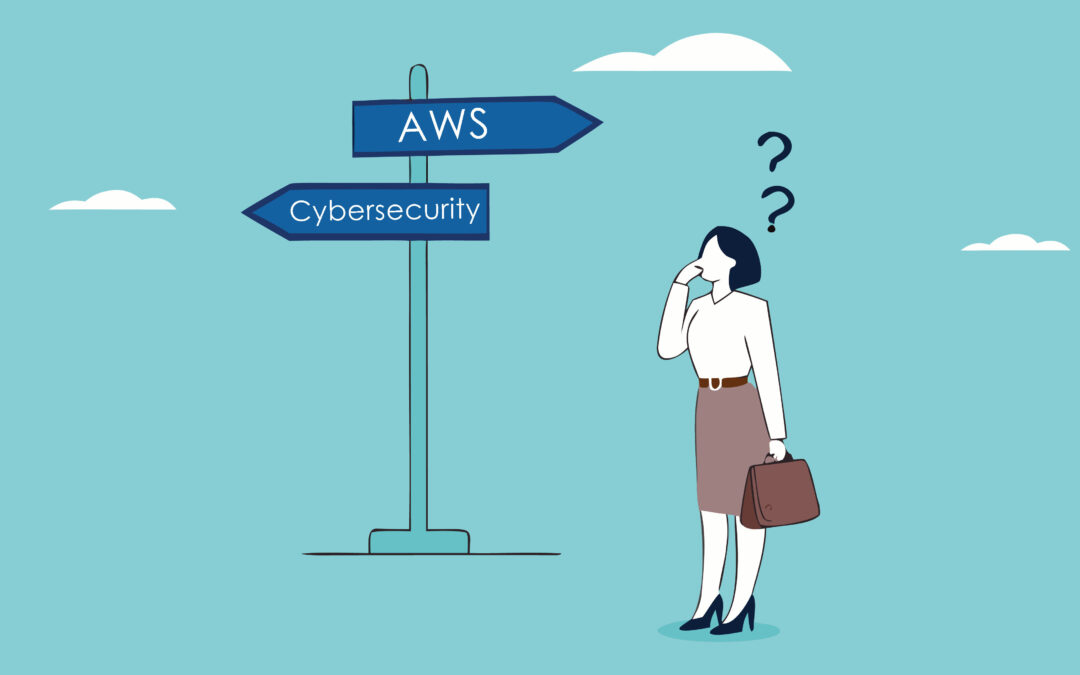
You have been thinking about it for months. Maybe longer. Every time you search “how to get into tech,” you land on two rabbit holes: AWS cloud computing and cybersecurity. Both have job postings everywhere. Both promise real career changes. And right now, you are stuck at the starting line, paralyzed by the question every career changer asks — which one do I choose?
Here is the good news: you are not alone in feeling overwhelmed. And here is the better news: there is no single “right” answer. The right choice depends on how you think, what you enjoy, and what kind of problems you want to solve every day.
What You Actually Do Each Day
AWS / Cloud Computing is about building and maintaining the infrastructure that runs applications and services. If you pursue this path, your day-to-day might involve designing scalable systems, configuring servers, managing storage solutions, and troubleshooting why a service went down at 2 a.m. You are the person who builds the house and keeps the lights on.
Cybersecurity is about protecting those systems and data from threats. Your day-to-day would involve monitoring networks for suspicious activity, responding to incidents, penetration testing (with permission), and constantly learning about new attack vectors. You are the person who locks the doors and figures out how an intruder got in anyway.
Both are technical. Both require ongoing learning. But the day-to-day mindset is different.
Job Demand and Market Reality
Both fields are in demand. That is not marketing speak — it is verifiable fact. Amazon Web Services (AWS) alone serves millions of active customers globally. Cybersecurity Ventures projects there will be 3.5 million unfilled cybersecurity jobs globally. In Northern Virginia specifically, we see consistent demand from government contractors and enterprise firms for both cloud architects and security analysts.
The difference is in the entry point. Cloud computing has a gentler on-ramp. You can start with the AWS Cloud Practitioner certification — no prior IT background required — and build from there. The concepts are logical and cumulative. CompTIA Security+ and CompTIA Network+ assume some baseline IT knowledge, which can make the first step feel steeper if you are coming from a non-technical background.
Starting Salaries — What New Cert Holders Actually Earn
Real numbers help more than promises.
In the Washington D.C. metro area, an entry-level AWS Cloud Practitioner or Solutions Architect (Associate level) often starts between $60,000 and $80,000, depending on employer and clearance requirements, according to BLS occupational data and LinkedIn Salary Insights. With a Security+ cert, an entry-level cybersecurity analyst can land in the $55,000 to $75,000 range.
Do not pick a field based on starting salary alone. The bigger factor is long-term growth and whether you will actually enjoy the work enough to keep growing.
Who Thrives in Each Field
AWS suits people who:
• Like building and configuring systems
• Enjoy infrastructure and automation
• Prefer clear, logical problem-solving
• Are motivated by scale and efficiency
Cybersecurity suits people who:
• Enjoy puzzles and problem-solving under pressure
• Are naturally curious about how things break
• Like continuous learning — threats evolve constantly
• Can handle ambiguity and investigation work
Here is a real example. I have seen a former logistics manager enroll in our AWS Solutions Architect program, struggle at first with networking concepts, then light up once they started building VPCs and deploying actual applications. Within eight months, they landed a cloud infrastructure role with a regional contractor.
I have also seen a former teacher come through our cybersecurity pathway. They had no IT background, but they had the mindset — they could not stop asking “but what if someone got into this system?” That curiosity carried them through Security+ and into a SOC analyst role.
The Honest Take
AWS is not “easier” and cybersecurity is not “better.” AWS has a more forgiving learning curve for absolute beginners. Cybersecurity offers fascinating, constantly evolving work — but the entry gate assumes more baseline knowledge, and the stakes feel higher from day one.
Neither path is the wrong choice. But one of them will fit your temperament better than the other.
If you are still not sure, that is completely normal. This decision deserves more than a Google search and a coin flip.
Take the Next Step — Free Academic Advising
At Tysons Institute, we offer free one-on-one academic advising sessions for prospective students. We will look at your background, your goals, and your concerns — and help you map out a realistic path forward. No pressure, no sales pitch. Just honest conversation.
If you are serious about making a career change into tech, this is where you start.
Book your free advising session at ti.edu and get the clarity you need to make this decision with confidence.